A pillow is bought on feel, but that feel can be specified. Filling, fill weight, ticking and size together decide how high a pillow sits, how much support it gives, how warm it sleeps and how it comes out of the wash. Whoever builds a pillow range is choosing those properties for their customer – deliberately or not.
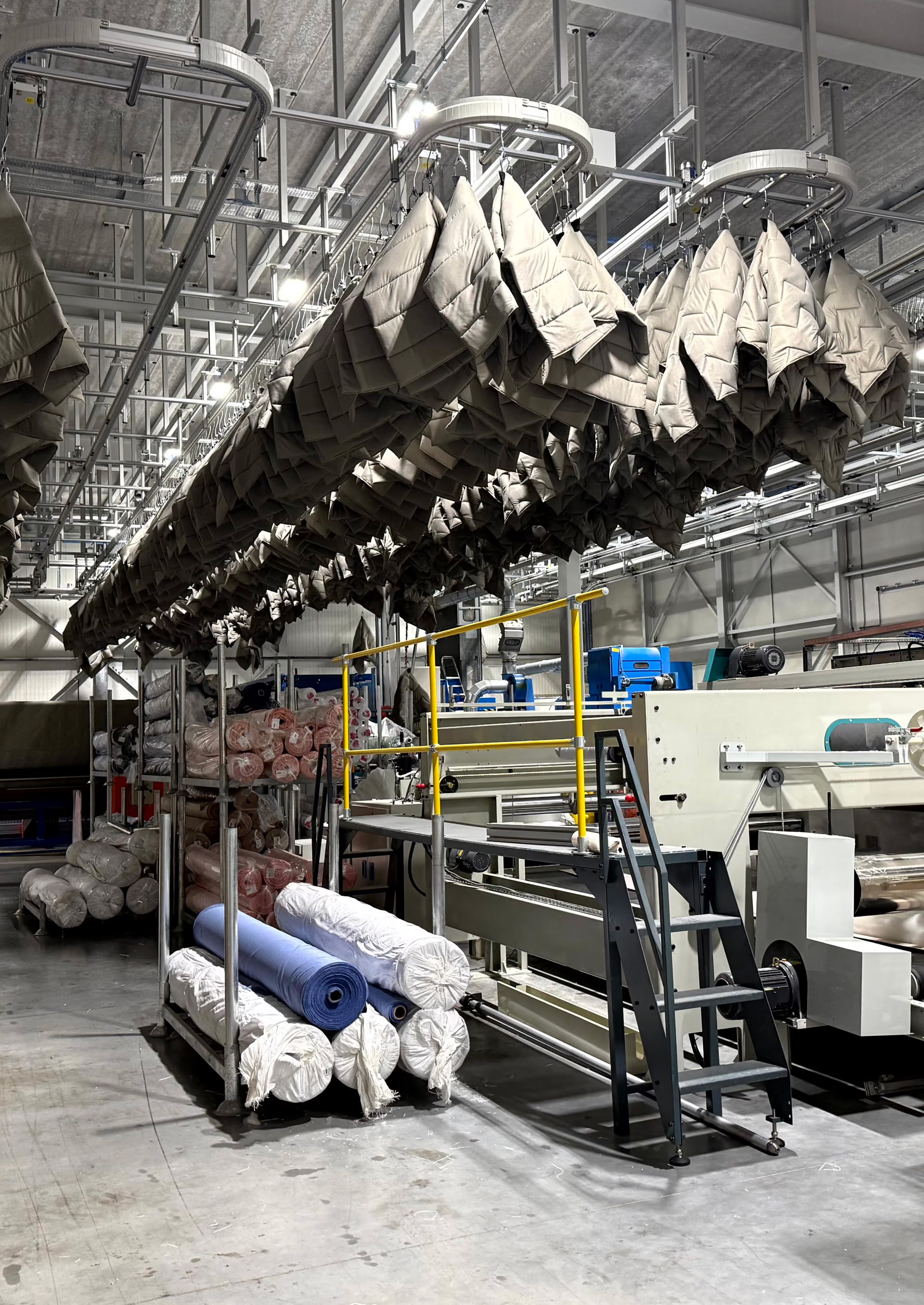
In our factory in Eindhoven we make synthetic-fibre pillows, memory foam and specialty pillows, and pillows with a natural filling, on eight fully automatic pillow lines (our pillow range). Below we set out what each filling does, which sleeper it suits, and how to translate the choice to your channel and price point.
First the terms: support, loft and resilience
Support is how well a pillow holds the head at the right height, so that neck and spine stay in line. Loft is the height of the pillow before a head rests on it. Resilience is how quickly it recovers after being pressed or plumped. Then there is the sleeping climate: how well filling and ticking carry away heat and moisture.
With fibre and down, fill weight largely decides loft and firmness: the same filling with more grams gives a higher, firmer pillow. With memory foam it is density and shape. Bear in mind that fill weight grows with size: an 80 × 80 cm pillow has twice the area of a 40 × 80 cm one. So fix the fill weight per size; the common sizes by country are in the size guide.
The fillings, one by one
Synthetic fibre
The backbone of almost every range. Usually this is hollow, siliconised polyester fibre: the hollow core traps air and keeps the pillow airy, while the silicone finish lets the fibres slide past each other, so they stay resilient and are slower to clump. A fibre pillow is light, affordable and usually washable, and fill weight tunes it from soft to firm. The trade-off: it flattens over time and wants plumping every day.
Within synthetic fibre there are finer variants that feel softer and downier. Nano gel fibre, one such very fine fibre, is what we use in our duvets; if you want that feel in a pillow, raise it in your briefing.
Memory foam and specialty pillows
Memory foam responds to warmth and pressure: it moulds to head and neck and recovers slowly. The result is stable, even support that stays the same all night, often in a contour shape with a neck roll. Foam can feel warmer than fibre; a breathable, removable cover helps. The foam core itself cannot be washed. Specialty pillows are designed for a particular sleeping position or use – think of a pillow for side sleepers, or a long body pillow.
Natural filling
Down and feathers are the classic natural pillow filling: soft, mouldable and breathable. The more down, the lighter and softer the pillow; feathers add weight and support. A natural pillow needs more care – washed rarely, always dried thoroughly – and belongs in the upper segment. That is also where our own brand Mont Blanc sits: natural, high-value bedding. If your market expects a certification of origin such as Downpass, tell us in the briefing.

Choosing by sleeping position
Sleeping position mainly decides how high and how firm a pillow should be. Rules of thumb that are easy to explain in store and online:
- Side sleepers need the highest, firmest pillow: it fills the gap between shoulder and head. The broader the shoulders, the higher.
- Back sleepers do well on a medium-height pillow that supports the neck without pushing the chin towards the chest.
- Stomach sleepers are best on a low, soft pillow, so the neck is not bent backwards.
- Combination sleepers benefit from a medium, mouldable pillow of fibre or down that can be plumped and shaped.
The mattress plays a part too: on a soft mattress the shoulder sinks deeper and a lower pillow will do. To make choosing easy, give every pillow in your range a clear firmness or sleeping position on the pack. That only works when the fill weights within the range are fixed – which they are with us, because every pillow is weighed automatically.
Allergies and washability
House dust mites feel at home in bedding. For people who are sensitive to them, a pillow that can be washed hot is the logical choice: synthetic fibre is often washable at 60 °C, if the care label allows it. Memory foam cannot be washed in the core, so the cover has to do the work. Natural fillings are washed less often and at lower temperatures. A pillow protector under the pillowcase keeps any pillow clean for longer, whatever the filling.
How to wash, dry and replace each filling is set out in use and care. That care belongs on the label and insert card too, in the languages of your market.
Describe what the pillow does
Terms like ‘anti-allergy’ look good on a pack, but what you may claim depends on your market and on what has been tested. Facts such as ‘washable at 60 °C’ or ‘removable, washable cover’ can be checked, and help the customer just as much.
Channel and price point
Most ranges work as a ladder: an entry pillow, a comfort pillow and a premium pillow. What sits on each rung differs by channel:
- Discount retailers and supermarkets: synthetic fibre in a few fixed fill weights, packed compactly, with a clear specification on the pack.
- Retail chains: the full ladder, from fibre, via a higher fill weight and a better ticking, to memory foam and a natural filling.
- Bedding specialists: memory foam, specialty pillows and natural fillings in several firmnesses, for the customer who wants advice.
- E-commerce and marketplaces: pillows that travel well roll-packed or vacuum-packed, with measurable data online – size, fill weight, firmness, washing temperature – so customers can compare.
- Hotels: washable fibre pillows to one fixed specification, with protectors; more in bedding for hotels.
The cost of a pillow depends mainly on filling, fill weight, ticking and packaging. We calculate it per article and per quantity for your programme; an enquiry with product, quantities and market is enough to start.
The fillings compared
| Filling | Support and shape | Climate | Washing | Best suited to |
|---|---|---|---|---|
| Synthetic fibre | Resilient; loft and firmness set by fill weight | Airy | Often washable, up to 60 °C per label | Every channel, allergy-prone sleepers, hotels |
| Memory foam | Shape-retaining and even, often contoured | Can feel warmer | Not the core; the cover, yes | Sleepers who want firm support |
| Specialty pillows | Designed for a position or use | Depends on the filling | Per label | A specific need, bedding specialists |
| Down and feather | Soft and mouldable; feathers add support | Breathable | Rarely; dry thoroughly | Premium and natural collections |
Tell us who the pillow is for and where it will be sold. We will put together a proposal with filling, fill weight, ticking and packaging, and make samples you can feel.
Request a quote