A line of pillows and duvets under your own brand sounds simple: a good product, a label, a bag. In practice it rests on a series of decisions — filling, ticking, sizes for each market, packaging, planning — that together decide whether the product fits your shelf and keeps selling. That is why every private-label project at HMG Bedtextiel follows the same six steps, with one point of contact from start to finish.
Below we walk you through them, from the first brief to the pallet at your distribution centre: what you can prepare at each step, what we do and what you get back. Our page on private label sums up the service; here we look at how it works.
First, one choice up front. What we make leaves the factory in one of two ways: under your own brand, or as Mont Blanc, the brand HMG has owned for more than 28 years.
| Private label | Mont Blanc | |
|---|---|---|
| Brand | Your brand on the label, band or insert card and packaging | HMG’s own brand, for more than 28 years |
| Product | A standing programme or an exclusive collection, from our range or developed for you | Natural, high-value bedding from the Mont Blanc collection |
| Best for | A line under your own name, retail-exclusive if you wish | A premium, natural segment under an established brand |
| Production | Our factory in Eindhoven, with the same quality control | Our factory in Eindhoven, with the same quality control |
The brief
A good brief saves sample rounds. The more concrete the starting point, the sooner the first proposal is right. You don’t need to know everything yet, but these six points help:
- Product: pillows, duvets, mattress toppers or protectors — and whether this is a new collection, an existing item or a second source alongside your current supplier.
- Market and channel: the countries you sell in, and how: as a discounter, retail chain or bedding specialist, through a web shop or marketplace, in DIY or pet stores.
- Quantities: the size of the first order and the expected annual volume, as an indication.
- Timing: a delivery date, or the season the product needs to be on the shelf for.
- Target price: the purchase price per piece you are aiming for. We match materials and construction to it.
- Packaging: how the product will be sold — in a bag with an insert card, roll-packed or vacuum-packed, or in bulk in an outer carton.
Do you have a tech pack, drawings or a reference product you want to match or improve on? Bring it to the table. Our quote request asks for exactly these points in five short steps; anything you don’t know yet, you simply leave open.
Development
With the brief in hand, we work out each item technically. The key choice is the filling: synthetic fibre, nano gel fibre, memory foam and other specialty fillings, or natural fillings such as wool and bamboo. It determines comfort, washability and a large part of the cost price. If you want sustainable, certified fibres such as GRS (Global Recycled Standard), we build that in at this stage.
Next come the ticking (the fabric around the filling), the construction, the fill weight and the finish. A pillow is stitched all round; a duvet is quilted into chambers so the filling stays in place. Then the sizes: a duvet has to fit the covers sold in your market, and a 135 × 200 for Germany is a different item from a 140 × 200 for the Netherlands. The usual sizes per country are in our size guide.
Finally, the label: what it has to say, in which languages, and how your brand appears on the woven label, the band or the insert card. This step produces a technical sheet for each item, and a quote.
Samples and approval
A spec sheet tells you a lot, but a pillow is something you want to feel. So we make prototypes for you to test, compare and put in front of your team or a customer panel. Your feedback goes into the next round, until the product is right.
Once you approve the sample, the specification and the print proofs for label and packaging, everything is fixed. That approved sample becomes the reference sample: the benchmark for the whole production run and for every repeat order after it.
Why the reference sample matters
The reference sample records what you approved: filling, fill weight, ticking, stitching, size, label and packaging. Every batch is checked against it. That way, the item you reorder in two years’ time is the same as the one you started with.
Production on fully automatic lines
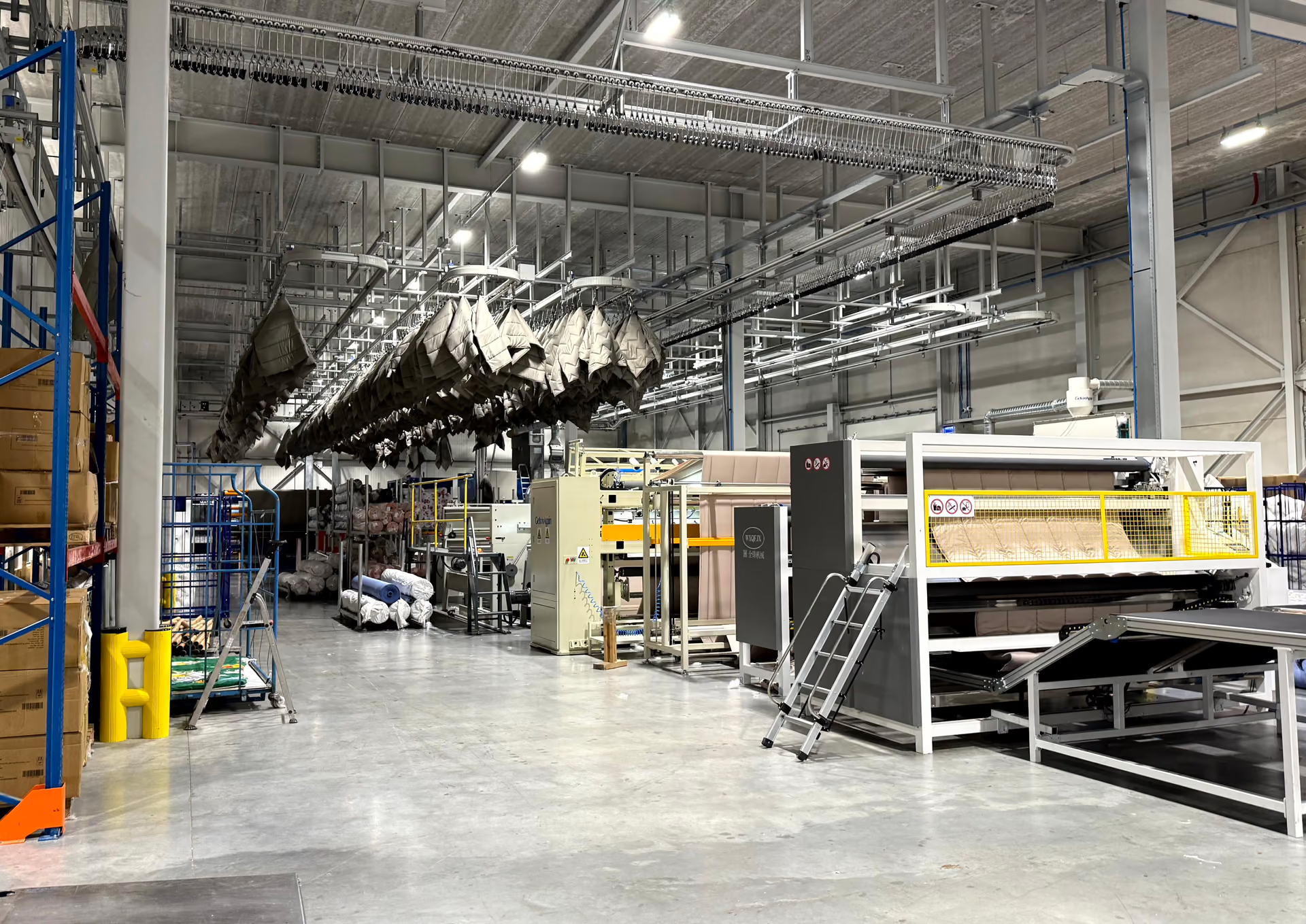
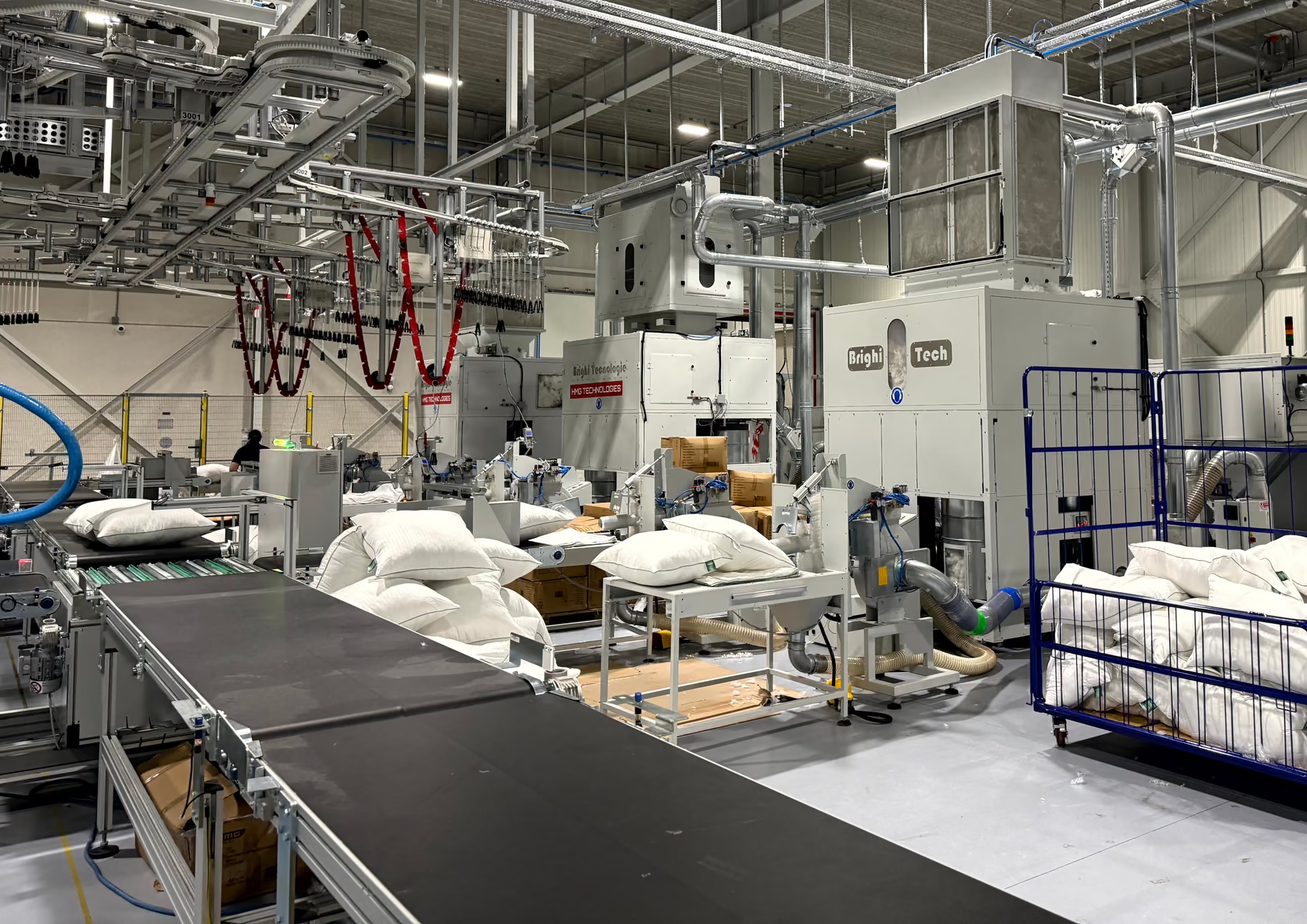
Your collection is made in our own factory at Park Forum in Eindhoven: 100% in the Netherlands. Pillows run on fully automatic pillow lines; duvets on fully automatic duvet lines that quilt the top and bottom fabric into chambers.
- Fully automatic pillow and duvet lines
- 8 + 4
- Pillows a year, at full capacity
- 15 M
- Duvets a year, at full capacity
- 2 M
- Our own factory in Eindhoven
- 12,500 m²
High-precision fibre-opening systems loosen the fibre, then the line fills and weighs automatically: a product is closed only when the weight is right. Quality control is built into every production step, and each batch can be traced back to its production and raw materials. With this capacity, a programme can grow with your volumes without you having to change supplier. For a look at the hall itself, read inside our factory.
Labelling and packaging
With private label, the product carries your brand from label to packaging. Which parts that involves depends on the product and the channel:
- Woven label with your logo, on the pillow or in the corner of the duvet.
- Band or insert card: the sales band around the pillow, or the card in the duvet’s bag, with the information shoppers choose by at the shelf.
- Mandatory information: composition, care instructions and barcode, in the languages of your market.
- Packaging: a clear bag with a handle for the shelf, or roll-pack or vacuum packaging for compact transport and shipping.
We help with the design and send you print proofs, so you see the result before anything goes to print. Which packaging suits which channel is the subject of packaging that sells and ships.

Warehouse and delivery
Finished products go into outer cartons on pallets, packed the way your distribution centre wants to receive them. In our own warehouse with 6,000 pallet positions, AGVs take the pallets to their place and our WMS tracks every carton and every pallet.
You can take an order in a single delivery or call it off in parts; the rest stays ready with us. We deliver across Europe, Scandinavia and the United Kingdom, and to customers in Turkey, the United States and Canada. Quantities, lead times and call-off schedules are agreed per programme, in the quote.
Do you have a private-label project in mind? Send us your brief — product, market, quantities, timing and target price — and we will discuss the next step with you.
Start your brief